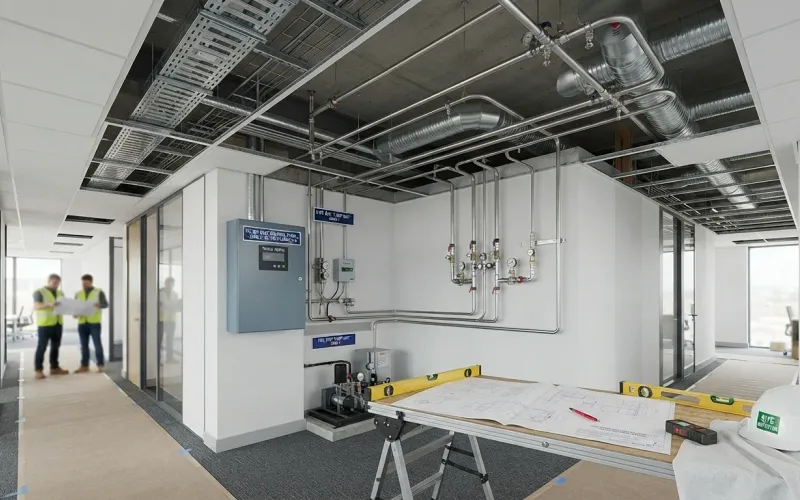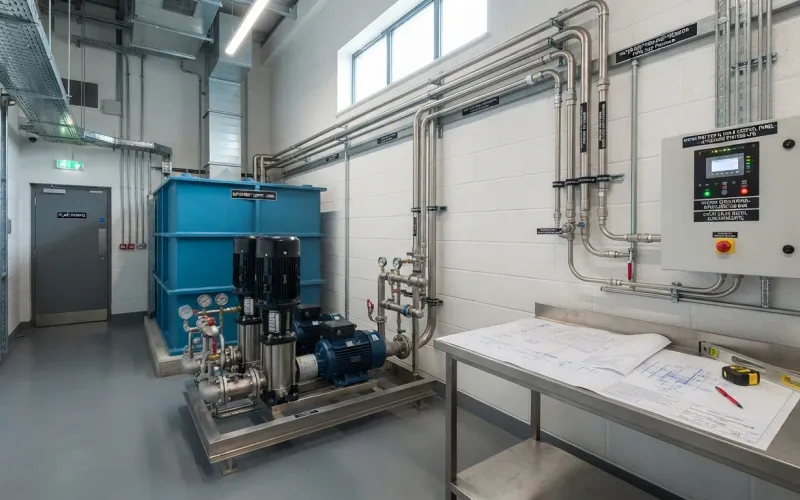
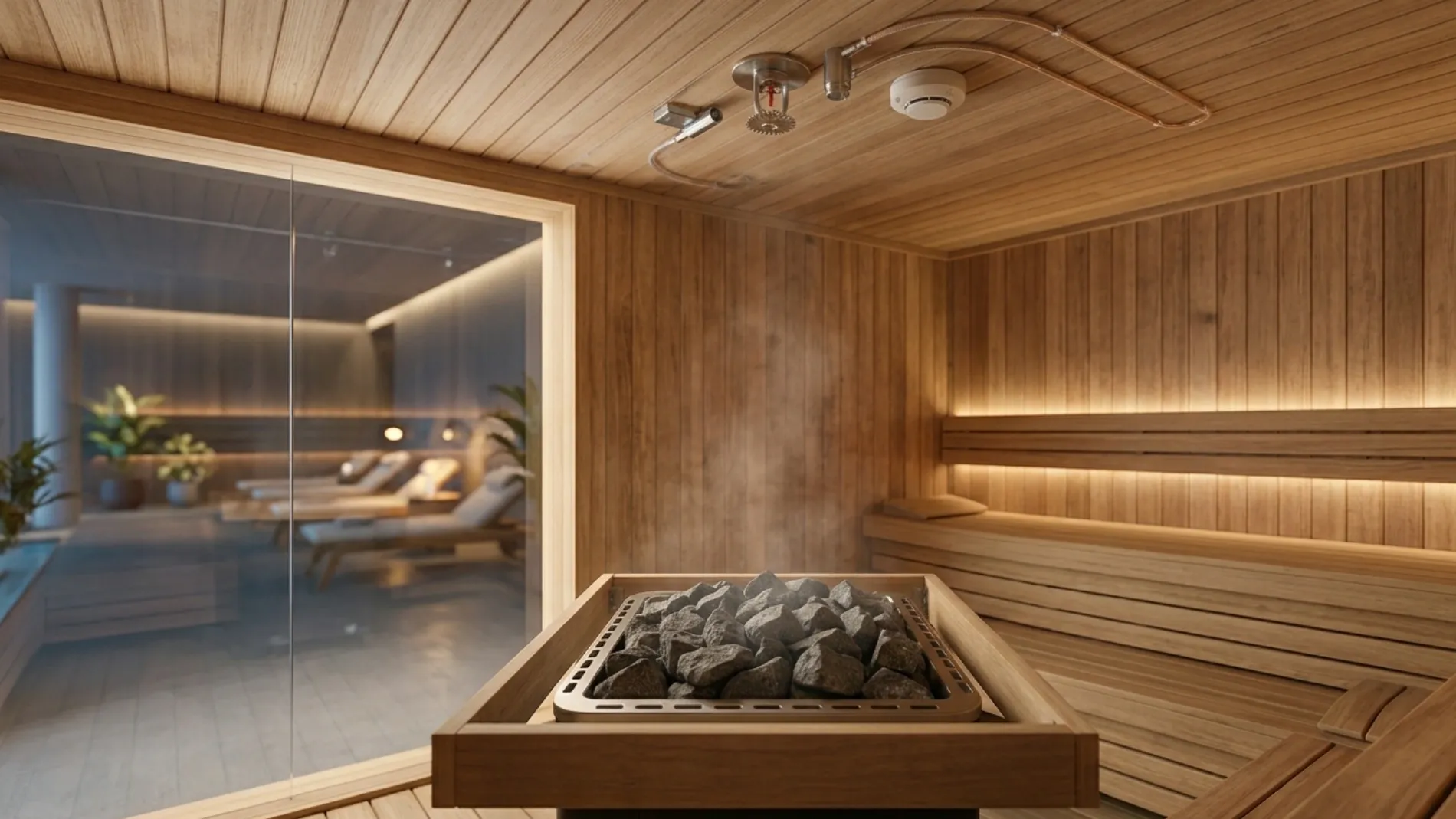
Sauna fire suppression for a commercial cabin has to deal with extreme heat, combustible linings, and concealed electrical faults. Full-scale insurer testing has shown how quickly conditions can escalate once ignition occurs. For hotel owners, gym and spa managers, health club operators, and architects, sauna fire protection should treat the cabin as a distinct hazard, not as a standard wet room with a heater attached.
The appropriate response is not to rule out water-based suppression, but to match system type, head rating, compartmentation, and maintenance to the risk profile identified in a suitable and sufficient fire risk assessment.
Why sauna fire protection is different
Unattended high-kilowatt heat sources
Commercial electric sauna heaters typically run between 6 kW and 12 kW, with some large cabin installations exceeding 15 kW. Wood-burning sauna stoves in hospitality settings add open-flame risk, hot ash management, and flue integrity as further failure modes.
These heat sources operate at surface temperatures well above the ignition point of surrounding materials if clearances are compromised or ventilation fails.
Dry timber lining as ready fuel
Sauna interiors are lined with kiln-dried timber, often cedar, hemlock, or aspen, chosen for its low moisture content and thermal properties. That same low moisture content makes the lining highly combustible once ignition occurs. A smouldering fault behind a panel can spread through the cladding before it becomes visible in the cabin.
Hidden voids behind wood panelling
Electrical heater connections, control wiring, and detection routes typically run in the cavity between the timber cladding and the structural wall. Electrical faults in these concealed spaces can smoulder undetected for extended periods, building pyrolysis gases until ventilation changes or structural movement triggers open flame.
This concealed ignition pathway helps explain why sauna fires often present as sudden, fully involved events rather than gradual smoke-generating incidents. Good housekeeping, heater clearance discipline, and regular electrical inspection are as important as suppression hardware.
Compartmentation and enclosure
Insurer and industry guidance consistently recommends that the sauna sits within fire-resisting construction providing at least 60 minutes fire resistance (integrity and insulation), both horizontally and vertically. Openings and penetrations through that compartment should be protected appropriately.
Compartmentation limits fire spread to the rest of the building while automatic detection, alarm, and suppression systems are given time to operate. It should be confirmed at design stage alongside ventilation routes, particularly where extract ductwork passes through fire-resisting boundaries.
Sprinkler protection: adaptation, not exclusion
Existing automatic sprinkler systems can often be extended to protect saunas, provided the design is adapted for the environment. Insurer guidance commonly specifies 141 °C rated sprinkler heads in place of standard 68 °C quick-response heads, with head selection and placement confirmed by a competent sprinkler designer against cabin operating temperatures and thermal stratification.
Where sprinklers are used, the following design factors should be reviewed:
- Head temperature rating matched to normal sauna operating conditions to limit spurious activation
- Thermal stratification in sauna interiors, where ceiling-level temperatures differ significantly from bench height
- Steam and scald risk if discharge occurs while the cabin is occupied
- Thermal shock and water damage to stones, linings, and adjacent spa finishes if activation logic is not considered
- Heat migration from the sauna cavity into adjacent wet-pipe zones, which can cause unwanted discharge outside the sauna
These are engineering considerations to resolve at specification stage. They do not mean sprinklers are unsuitable; they mean generic occupancy assumptions should not be applied without review.
Other suppression and detection options
The right solution depends on the building, insurer requirements, and the fire risk assessment. Common approaches include:
High-temperature sprinkler extension
Extending the building sprinkler system into the sauna with correctly rated heads is a well-supported route where sprinklers are already specified or required for the wider premises.
Water mist systems
Water mist systems designed to BS 8489 and BS EN 14972 can be appropriate where a risk assessment and insurer review support them. Fine-droplet discharge can provide rapid cooling with lower water volumes than conventional sprinkler flow in some layouts, which may reduce collateral damage in spa environments. Suitability depends on compartment geometry, ventilation, and test evidence for the specific application. See our water mist systems page for how that design is approached.
Pre-action or dry-pipe logic
A pre-action system admits water only after a confirmed detection signal, which can reduce accidental discharge risk in high-value adjacent areas. This is a conditional design choice, not a universal sauna standard. It may be worth considering where water damage to neighbouring revenue spaces is a primary concern and where the fire risk assessment supports dual-confirmation activation.
Linear heat detection in concealed voids
Linear heat detection cables behind timber panelling can give early warning of smouldering faults in cavities that are difficult to inspect visually. They are a useful optional enhancement where concealed electrical routes or wood-burning flue paths create additional risk, particularly when linked to alarm or pre-action logic. They are not a substitute for compartmentation, maintenance, or an agreed suppression strategy.
Compliance and commercial leisure safety standards
Commercial saunas in the UK sit within several regulatory and best-practice frameworks. Requirements differ between England and Wales, Scotland, and Northern Ireland; the points below are a summary, not a compliance checklist.
- Building Regulations (Approved Document B in England, or equivalent devolved guidance) — functional requirements for fire safety in commercial leisure premises
- BS 9999 — code of practice for fire safety in the design, management, and use of non-residential buildings; a risk-based framework, not a substitute for statutory compliance
- BS EN 12845 — where automatic sprinkler systems are specified, including head temperature ratings and design density for the occupancy
- The Regulatory Reform (Fire Safety) Order 2005 (England and Wales) — duties of the responsible person for fire risk assessment, including sauna equipment maintenance and emergency procedures; Scotland and Northern Ireland have separate fire safety legislation
- Insurer and operator standards — guidance such as RC50 (fire safety in the construction and use of saunas) and insurer technical bulletins increasingly require a documented sauna fire strategy
A documented fire risk assessment for the sauna should address heater maintenance schedules, timber lining condition, electrical inspection intervals, housekeeping rules, and staff emergency procedures, including evacuation of adjacent spa areas.
Design checklist for architects and operators
Before specifying or operating a commercial sauna, confirm the following with your fire engineer and insurer:
- The sauna is enclosed in fire-resisting construction providing at least 60 minutes fire resistance, unless an alternative strategy is agreed and documented
- The fire strategy treats the sauna as a distinct hazard, separate from standard wet leisure areas
- Suppression type (sprinkler extension, water mist, or other) is selected on the basis of the fire risk assessment and insurer requirements
- Sprinkler heads, where used, are rated for sauna operating temperatures (141 °C heads are commonly specified)
- Concealed voids are considered for optional linear heat detection where the risk assessment warrants it
- Heater electrical connections are accessible for periodic inspection
- A high-temperature limit switch or equivalent safeguard isolates the heater if thermostats fail
- Ventilation failure scenarios are considered in the fire risk assessment
- Staff are trained on sauna-specific emergency procedures, including steam scald awareness
- Maintenance records for heater elements, wiring, and detection systems are current and auditable
Protecting guests, staff, and your operation
Sauna fires in commercial settings can cause disproportionate business interruption: spa closure, reputational damage, insurance claims, and regulatory investigation. The cost of proportionate compartmentation, suppression, and maintenance is typically modest compared with the operational exposure of an inadequately considered fire strategy.
Designing or upgrading a commercial sauna? See our sauna fire suppression page, or contact us to arrange a site review with our fire suppression engineers.