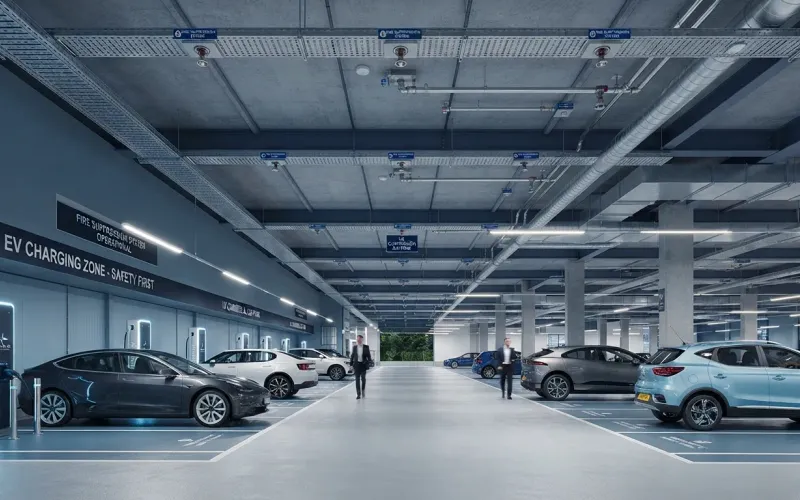

Underground and multi-storey car parks have always been demanding fire environments. Low ceilings, limited ventilation, constrained access, and the structural load of the building above compound the hazard. High-capacity EV charging infrastructure and commercial fleet fast-charging hubs add a further layer of complexity that generic building assumptions may not fully address.
For property developers, commercial landlords, parking operators, and logistics fleet managers, a credible fire strategy is increasingly expected by insurers, tenants, and reviewing authorities. It should be proportionate to the risk, documented, and kept under review.
Why EV fires change the underground parking hazard
An EV battery fire in an enclosed car park remains one of the more severe scenarios a building operator can face. England's interim government guidance on covered car parks and electric vehicles (which applies to new and existing covered car parks in England) identifies specific fire safety considerations for EVs and chargepoints. Scotland, Wales, and Northern Ireland have their own regulatory frameworks; the principles below reflect common UK fire engineering practice but should be confirmed against local requirements.
Severe heat in confined geometry
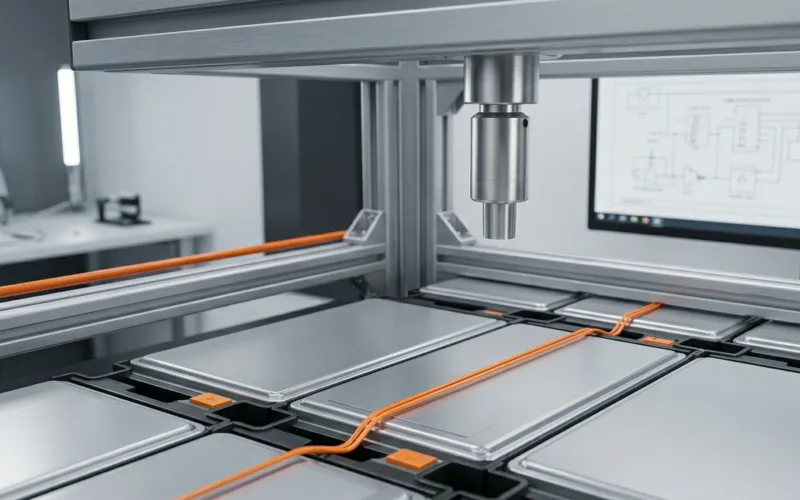
Lithium-ion thermal runaway produces intense, sustained heat that can accelerate fire spread to adjacent vehicles and structural elements. In a low-ceiling underground environment, heat reflects off concrete soffits and deck surfaces, and radiant heat transfer in enclosed parking is typically more aggressive than in open-air lots.
Toxic smoke, reignition, and venting
Battery fires release a complex mix of gases, including hydrogen fluoride (HF), carbon monoxide, and volatile organic compounds, which can accumulate in poorly ventilated below-ground spaces. Official summaries of the interim guidance also highlight reignition risk, compressed gas venting, toxic smoke, and difficult firefighting conditions in covered car parks. Ventilation and smoke management should be reviewed for the specific layout rather than assumed adequate from a generic design.
Fire service access limitations
Many underground car parks have restricted entry dimensions, ramp gradients, and turning circles that prevent standard fire appliances from reaching the seat of a fire. Fire crews may need to operate from the entrance, some distance from the incident, extending response times while conditions develop.
Structural integrity under sustained load
Prolonged high-temperature exposure to post-tensioned concrete decks, steel reinforcement, and waterproofing membranes can affect structural performance. An EV fire that burns for hours, which is common in runaway events, can pose a threat to the building above as well as to the vehicles involved. Longer fire resistance periods for structural elements are among the mitigation measures the interim guidance invites designers to consider.
Fleet depots and EV charging hubs
Commercial fleet electrification concentrates risk. Unlike public car parks where a single EV among many ICE vehicles might be present, fleet depots and dedicated charging hubs often run high thermal loads continuously.
Typical considerations include:
- Multiple fast chargers operating simultaneously — from 50 kW to 350 kW per unit, generating sustained heat in cable runs, connector housings, and adjacent vehicle battery packs
- Scheduled overnight charging — vehicles often unattended during peak charging windows, reducing the opportunity for early human intervention
- High vehicle density — commercial fleets parked with minimal separation, enabling rapid fire propagation
- Mixed asset classes — vans, HGVs, and passenger EVs with different battery chemistries, pack sizes, and failure modes in the same facility
A single runaway event in a fleet charging hub can escalate to a multi-vehicle incident if detection, suppression, and isolation are not planned and tested as part of the fire strategy.
A risk-based protection strategy
The interim guidance does not prescribe one universal system. It frames covered car parks as needing a risk-based strategy that may include suppression, early detection and alarms, structural fire resistance, vehicle spacing, firefighting water supplies, runoff containment, chargepoint location, smoke management, and thermal imaging. The measures below are design options to evaluate in fire risk assessment and fire engineering review, not mandatory requirements for every site.
Early detection and alarms
Early warning gives staff and fire services more time to isolate hazards and protect adjacent assets. Conventional detection may be supplemented where the risk assessment supports it.
Off-gas detection is a specialist approach in which sensors aim to identify electrolyte vapours and early decomposition products before visible fire or smoke. Where specified and maintained correctly, off-gas systems can potentially:
- Support isolation of an affected charging circuit
- Trigger localised suppression or enhanced ventilation in a defined zone
- Alert on-site security and fire services with location data
This remains an emerging design option rather than a universally established standard. Sensor selection, placement, integration with the building management system (BMS), and maintenance should follow manufacturer guidance and be agreed with the fire engineer and insurer.
Suppression: sprinklers and supplementary systems
Automatic sprinklers are among the mitigation measures identified in summaries of the interim guidance, alongside early detection and longer fire resistance periods. For many covered car parks, extending or providing sprinkler protection remains a proportionate baseline for structure and occupancy.
Where the fire risk assessment identifies concentrated EV charging risk, supplementary localised suppression — such as deluge or high-pressure water mist scoped to individual bays or charging zones — may be worth considering to apply targeted cooling at the hazard. This is a risk-based addition, not a blanket replacement for sprinklers.
Design considerations for any supplementary system include:
- Per-bay or per-charger coverage mapped to vehicle dimensions and charger placement
- Activation logic linked to detection appropriate to the design (thermal, multi-criteria, or off-gas where specified)
- Water mist or deluge selection based on compartment height, ventilation, and water supply capacity
- Post-discharge monitoring to manage re-ignition risk during the extended cooling phase
Water mist systems for buildings are covered by standards including BS 8489 and BS EN 14972. They are one valid protection route where test evidence, insurer review, and the fire strategy support their use. System design, testing, and maintenance should be carried out by competent specialists.
Fire blankets
Heavy-duty fire blankets are used tactically by some UK fire and rescue services in specific circumstances. They are not a primary building control measure and do not extinguish thermal runaway.
Blankets should not be positioned in guidance as a standard expectation for untrained on-site staff. Where they exist on a site, deployment is normally a fire service decision, supported by gas monitoring and thermal imaging, with attention to continued off-gassing and vapour cloud risk if misapplied. Any on-site provision requires a written procedure agreed with attending crews, not ad hoc use by parking staff.
Designing protection for new and retrofit projects
Whether you are specifying fire strategy for a new-build underground car park or upgrading an existing facility for EV charging, early engagement with a fire engineering specialist pays off.
New-build projects can integrate detection and BMS logic at design stage, size water supplies and risers for sustained cooling demand, coordinate ventilation with alarm sequences, and model EV scenarios in the fire strategy report.
Retrofit projects often face constraints: sensor placement may be limited by existing cable routes; supplementary tanks or pumps may be needed; ventilation sequencing may require reprogramming; and operational plans must be updated to reflect what the building can realistically deliver.
Aligning the strategy with insurer expectations and the reviewing authority before charging infrastructure is installed reduces costly rework later.
Compliance and commercial responsibility
Building Regulations (Approved Document B in England, or equivalent devolved guidance), BS 9999, insurer requirements, and interim government guidance on EV risks in covered car parks (England) provide a framework for design. That guidance is explicitly interim and risk-based; it should not be read as a finished national code.
Commercial landlords and parking operators owe a duty of care to tenants, users, and adjacent occupiers. Documented fire risk assessment, tested alarm-to-response sequences, and staff emergency procedures are increasingly required by insurers and major commercial tenants as a condition of lease or occupancy.
Protecting your car park or charging hub starts with a site-specific assessment. See our EV car park fire protection page, or contact us to discuss your project and arrange a bespoke risk assessment.