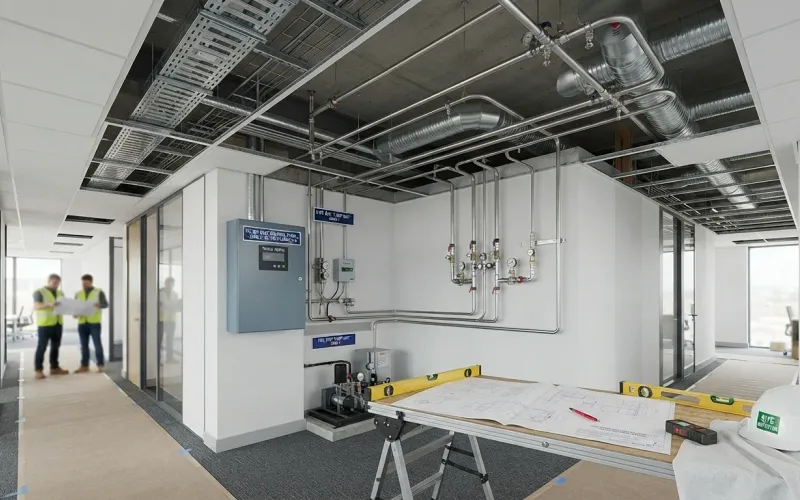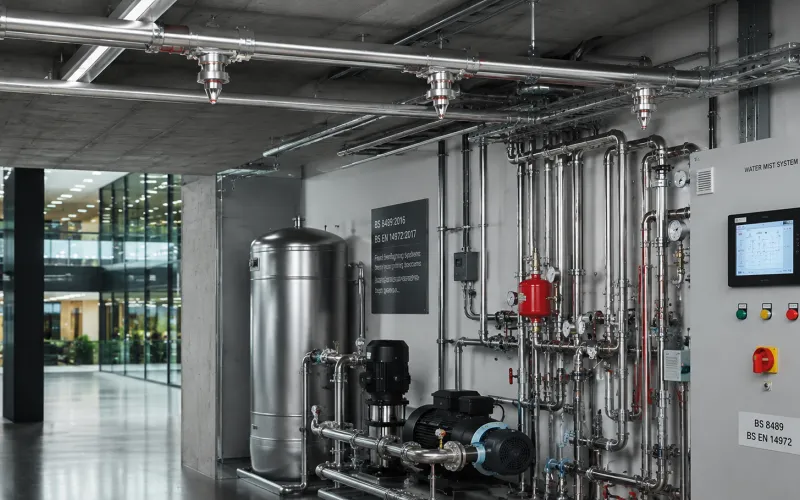
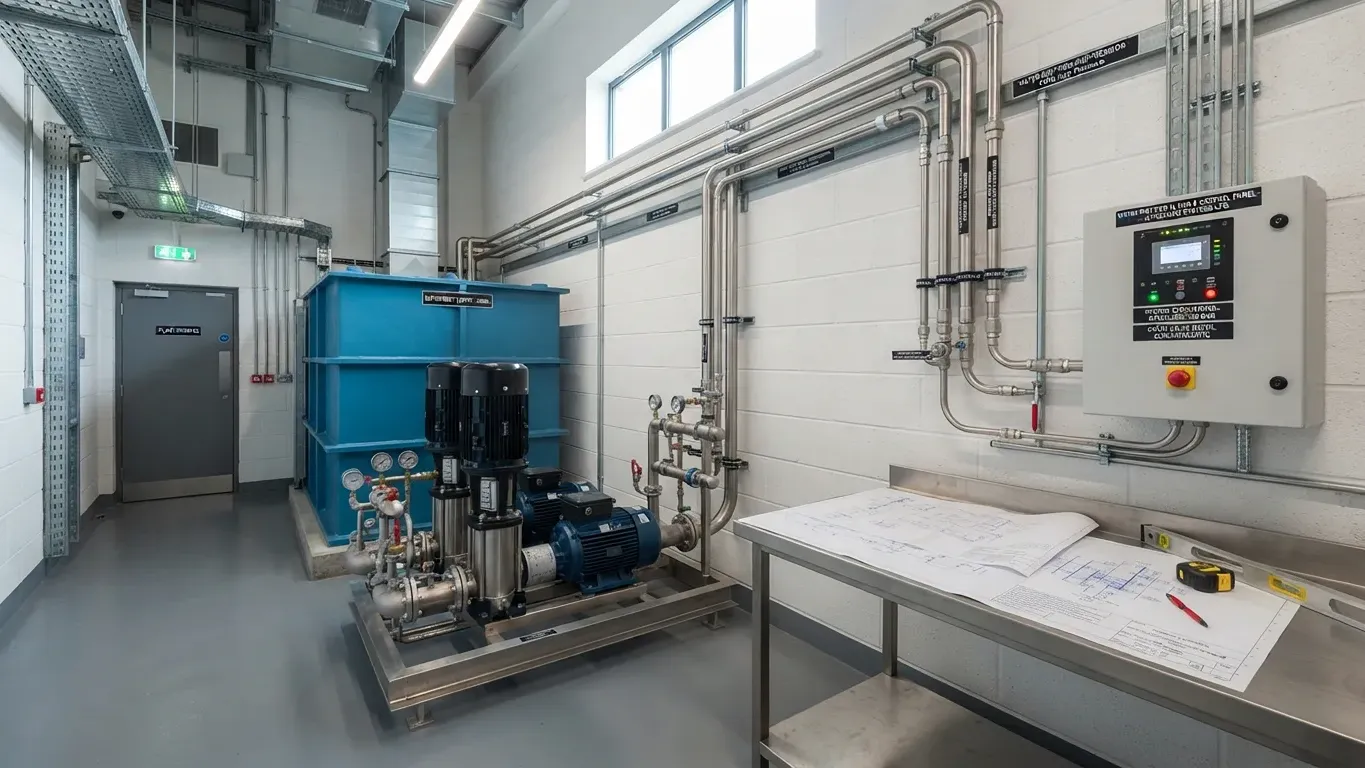
Water mist remains one of the most discussed fire protection options for commercial and industrial buildings. It is often chosen where lower water volumes matter, where space is constrained, or where a conventional sprinkler solution is impractical. But if you are budgeting for a system, the first question is usually the same: how much does a water mist system cost, and is it the right fit for this building?
The honest answer is that water mist cost depends on the project. There is no single authoritative UK price that fits every site. A compact localised system for a plant-room hazard is not the same as a full-building protection scheme for a data hall, commercial kitchen, or car park. The right way to assess value is to look at the project scope, the hazard, the maintenance profile, and the level of protection needed.
This guide explains the main cost drivers, the lifecycle considerations, and how to judge the value case without relying on misleading headline figures. It also sets out the limits of any positive payback narrative: some projects may have a weak cost-benefit profile, especially in retrofit or constrained conversions.
If you are comparing options for a live project, start with the actual hazard and the site conditions. The design basis, water supply, and inspection strategy matter as much as the name of the technology.
A realistic view on cost
Water mist systems are often described as more expensive upfront than conventional sprinklers, especially on retrofit or complex projects. In many practical comparisons, the installed cost can be noticeably higher than an equivalent sprinkler installation, particularly where the project needs pumps, tanks, zoning, controls, and careful design work.
That said, the comparison is not always simple. A mist system can be more cost-effective where:
- the building has limited water supply or restricted fire-water infrastructure
- the protected area is compact or high-value and collateral damage matters
- sprinklers are impractical or not the best fit for the room geometry or hazard
- the project needs a lower-water, lower-damage approach with a careful design basis
The key point is this: the price of a water mist system is not only about the nozzles. It is about the entire design, installation, water supply, controls, commissioning, and the ongoing service burden.
What drives the cost of a water mist system?
1. System type and pressure regime
A major cost difference comes from whether the system is high-pressure or low-pressure and whether it is designed for local application or broader coverage.
High-pressure water mist systems typically involve more specialised plant, pumping arrangements, and hydraulic design. They can be an excellent choice for certain applications, but they are not automatically the cheapest option. Low-pressure mist systems may be suitable in some settings, particularly where the geometry and risk profile support a lower-pressure arrangement.
The right design depends on the hazard, room size, ventilation, and how the system is expected to perform under fire conditions. Cost should not be assessed simply by picking one general category of mist system.
2. Size and complexity of the protected area
The larger the protected area, the more the project will depend on:
- pipework length and routing
- nozzle quantity and spacing
- pump and tank sizing
- whether the system is zoned or localised
- how the system interfaces with detection, alarms, and cut-off controls
A compact localised protection system is very different from a whole-building mist installation. The same is true when comparing a one-room switchgear area with a multi-zone food production facility or a car park charging zone.
3. Water supply and storage requirements
Water mist systems are often selected because they use less water than some traditional sprinkler designs, but they still require a carefully designed water supply. The cost can rise significantly if the project needs:
- dedicated water storage tanks
- high-pressure pumps
- filtration or water treatment
- larger infrastructure for flow and pressure
- additional plant-room space
This is one of the biggest variables in project pricing, especially in retrofit work or constrained buildings.
4. Detection, controls, and interfaces
A water mist system rarely sits in isolation. On many projects it must integrate with:
- smoke or heat detection
- fire alarm panels
- shut-down logic for fans, HVAC, process equipment, or fuel lines
- BMS or building management interfaces
- local alarms and supervisory controls
The more integrated the system, the more engineering and commissioning time may be required. That is a genuine cost driver, not a minor technical detail.
5. Installation constraints and access
A system installed in a new-build space is usually simpler than a retrofit in an existing building. Access can make a big difference to cost, especially if the installation requires:
- extensive ceiling works
- service coordination with M&E plant
- route planning around ductwork, cable trays, or structural members
- phased installation with ongoing building use
Retrofit projects often carry more risk and more labour time than new build because the design has to work with real-world constraints rather than a clean sheet.
6. Design evidence, standards, and compliance review
The project scope also depends on the design basis and evidence required by the client, insurer, fire engineer, or authority. New project work should align with the relevant current standards for water mist systems, and it is important to confirm the exact parts and editions being used.
For residential and domestic-type mist applications, BS 8458:2015 was superseded by BS EN 14972-17:2025. BS 8489-5 is withdrawn. BS 8489 also does not have numbered parts 2, 3 or 15 in the way some briefs or legacy references imply, and project teams should avoid using outdated shorthand when preparing a new design basis.
For commercial and industrial schemes, designers should check the relevant BS EN 14972 parts for the intended application and should not rely on generic statements such as “compliant with water mist standards” without identifying the system type and the hazard basis. Car park and larger enclosed parking applications are commonly assessed under the relevant BS EN 14972 application family, not by a generic “sprinkler alternative” assumption.
That makes specification and design quality more important than simply naming a standard on a quote.
Typical cost positioning: ranges and ratios, not fixed prices
There is no universally accepted single “£ per m²” figure for all water mist systems. In practice, project cost is influenced by system type, hazard, layout, water storage, plant, and installation complexity.
A useful working benchmark is this:
- A Scottish Government cost-benefit study of automatic fire suppression in traditional buildings converted to hotels framed water mist (then referenced to BS 8489) as around 30-40% more expensive per head than equivalent BS EN 12845 sprinkler installations in that comparison.
- This is a relative benchmark for a defined comparison and not a universal rule across all sectors or all project scopes.
- In some applications, the difference may shrink or be offset by lower collateral damage, reduced water use, or a better fit for the room geometry and risk profile.
- In other cases, including some conversion projects, the cost-benefit ratio may be adverse, so benefit-cost claims should be treated cautiously.
It is also worth remembering that long-term cost is not only installation cost. A system that looks cheaper upfront may create more water damage risk, more maintenance complexity, or less suitability for the actual hazard.
Ongoing costs: maintenance, testing, and inspections
The lifecycle cost of a water mist system is not limited to installation. Commercial systems typically require regular inspections, servicing, and records to maintain performance and compliance.
In general, the typical maintenance profile includes:
- annual inspection by a competent person
- periodic pump and control checks
- visual checks and system functional review
- manufacturer-specific maintenance requirements
- nozzle testing or removal and inspection at intervals defined by the system supplier or design basis
The exact intervals vary by system design and manufacturer guidance. In many cases, nozzle testing is not a one-off event. It can be required after an initial period and then repeated at defined intervals, with a common pattern being an initial test after a longer service period followed by regular re-testing thereafter.
The commercial systems market also tends to involve more frequent inspections than residential or domestic schemes, with routine checks often supported by annual service plans and more formal testing records.
For buyers, this matters because a mist system is not a “fit and forget” option. It needs proper inspection and maintenance so the system remains ready and documented when it matters most.
Where water mist may present a defensible value case
The strongest case for water mist is not a blanket claim that it always pays back more quickly than sprinklers. It is where a lower-water, lower-damage system matches the actual hazard and helps protect business continuity, high-value assets, or spaces where other solutions are impractical.
1. Reduced water damage
Water mist usually uses much less water than many conventional sprinkler systems. In some occupancies, that can reduce cleanup, property damage, and downtime after activation. For insurers, asset owners, and operators, that can be a major benefit when the protected space contains sensitive equipment or high-value stock.
2. Suitability where sprinklers are impractical
In some environments, sprinklers are not the best engineering solution. This could be due to ceiling height, the value of the asset, the risk profile, or layout constraints. Water mist may offer a more appropriate solution when designed properly, especially in controlled or compartmented spaces.
3. Minimal disruption in sensitive areas
Some projects cannot tolerate large volumes of water or major pipework. Mist systems may be easier to integrate where water discharge risk is a concern, or where a compact, targeted solution is more appropriate than a wider automatic sprinkler installation.
4. Protection of operations and continuity
For commercial sites, the real value may not be the price of the system itself. It is the ability to protect the asset, reduce fire spread, and help the building return to operation sooner after a fire event. That can translate into lower business interruption exposure and better resilience.
A cautious buyer should treat any payback claim as a project-specific assessment rather than a guaranteed result. In some retrofit conversions, cost-benefit analysis may still be adverse even where a mist system is technically suitable.
What to ask for in a quote
A serious quote should do more than list nozzles and pipe sizes. Buyers should ask for:
- the design basis and which standards or parts are being used
- hazard classification or protected area design basis
- hydraulic calculations and system design assumptions
- pump, tank, and water storage requirements
- controls and interfaces with fire alarm or BMS systems
- commissioning and testing scope
- maintenance and service plan
- insurance or authority expectations that affect the design
If a quotation is vague about standards or risk basis, treat it as a warning sign. A water mist system is a performance-based fire engineering solution, and design quality matters as much as the product itself.
Should you buy a water mist system?
Water mist can be an excellent fit when the project requires a carefully tuned, lower-water solution and the room or hazard is suitable for it. But it is not automatically the best option for every building.
The decision should rest on:
- the actual fire risk assessment
- the building geometry and the room layout
- the protection objective
- local standards, insurer expectations, and authority requirements
- maintenance strategy and the availability of competent servicing
A good project team will treat cost as one part of the decision, not the whole decision.
Final thought
If you are comparing fire protection options, the right question is not simply “Which is cheaper?” It is “Which system provides the right level of protection for this hazard, this building, and this operating reality?”
For many commercial and industrial applications, water mist is a strong solution when it is engineered appropriately. But the best value is achieved when the design is matched to the actual risk and the project lifecycle is considered from the outset. A low-cost system that is poorly matched to the room conditions is rarely a bargain in the long term.
If you are planning a project, a site-specific review is the best way to compare the true cost, risk, and lifecycle value of different fire protection strategies. It will help you avoid paying for a solution that looks attractive on paper but fails to reflect the real conditions of the site.
For a project-specific review of water mist protection and cost planning, see our water mist systems page or contact our engineering team.