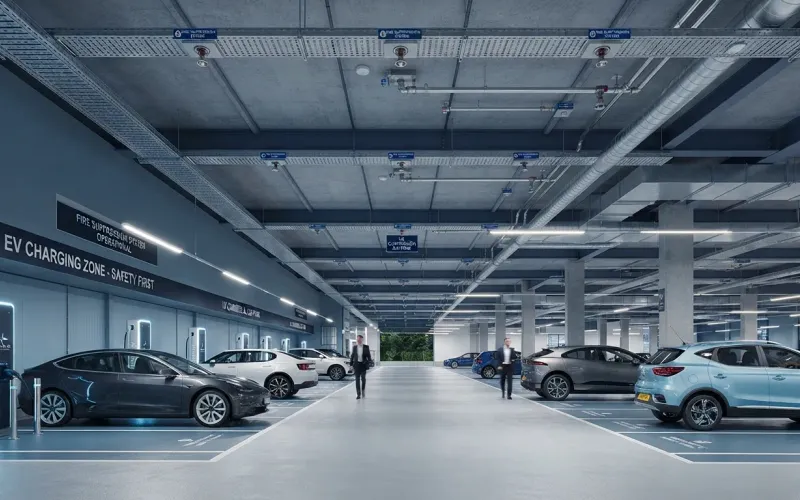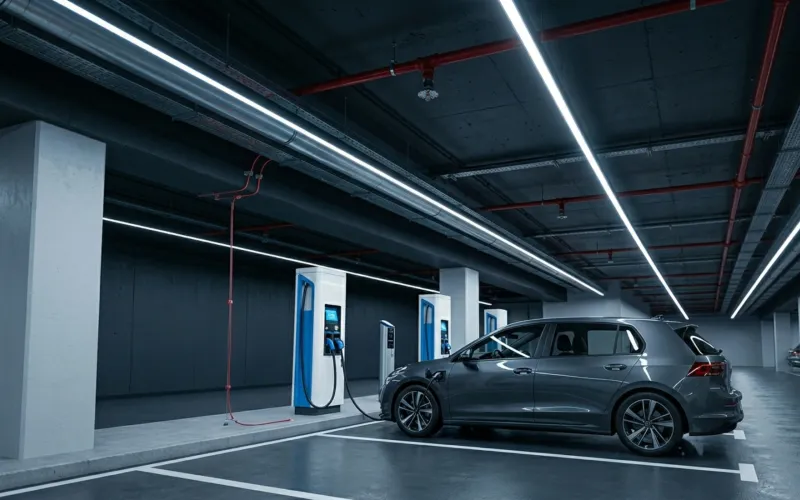
Covered and underground car parks were already demanding fire environments. Add high-capacity EV charging and the hazard profile changes again: thermal runaway, re-ignition, smoke, and longer cooling times than a conventional vehicle fire.
The response is a layered strategy, not a single product. Detection, ventilation, suppression, structural assumptions, fire-service access, and operating procedures all belong in the same review. Our article on fire suppression for underground car parks and EV charging hubs sets out why.
Where sprinklers help, and where they do not
Traditional sprinklers still have a role in protecting the building. They are usually not enough on their own to manage a battery fire in a congested charging bay. Water mist, deluge, or other localised measures may be appropriate in some layouts. None of those is a universal EV solution.
Landlords and fleet operators also face an insurance conversation. Insurance, compliance, and EV fires covers the evidence that reviewing parties typically ask for, and why England's interim guidance is not automatically the position in the rest of the UK.
What we need to design
Drawings, charging specification, whether the deck is underground, ventilation strategy, and any insurer or fire-authority comments. From that we can say whether mist, sprinklers, detection upgrades, or a hybrid approach is even in play.
Contact our engineers before charging infrastructure is treated as a services extra on a generic car-park fire strategy.