Commercial kitchens and food production lines present a demanding fire risk profile for hospitality and manufacturing operators. Open heat, cooking oils, grease-laden extract systems, and continuous process equipment can create ignition sources that escalate quickly if detection and suppression are poorly matched to the hazard.
For restaurant groups, hotel operators, contract caterers, and food manufacturers, cooking and process areas should be treated as distinct risks within the wider building fire strategy - subject to a suitable and sufficient, site-specific fire risk assessment.
Why kitchen and process fires escalate
Cooking oils and high surface temperatures
Deep fryers, industrial fryers, and oil-based cooking lines operate at temperatures where fats and oils can ignite if overheated, spilled, or left unattended during peak service. Once alight, oil fires can reignite if the fuel is not cooled or blanketed adequately. Applying water incorrectly can worsen the situation by spreading burning oil.
Grease in extract systems
Canopies, filters, ducts, and fans accumulate grease over time. A fire that starts at the cooking surface can travel into the extract system and spread beyond the kitchen if ductwork is poorly maintained or inadequately protected. Regular cleaning to recognised industry practice is part of fire safety, not only hygiene.
Process equipment and continuous lines
Food factories often add conveyor ovens, fryers, dryers, and packaging areas where heat, product residue, and mechanical plant sit close together. Unattended overnight cooking cycles, limited staff coverage, and large floor plates can make early detection and localised protection particularly important - where the fire risk assessment identifies that need.
Occupancy and business interruption
Kitchen fires can close restaurants and hotel food service immediately. Production-line fires can stop manufacturing sites. Even a contained incident may trigger food safety shutdowns, deep cleaning, and insurer scrutiny. Suppression choice should weigh collateral water damage against downtime, as assessed for that site.
Suppression options: match the hazard
No single system suits every kitchen or plant. The appropriate mix depends on equipment type, enclosure, extract design, insurer requirements, and the fire risk assessment. The options below are design considerations, not a ranking of preferred products.
Local application for cooking equipment
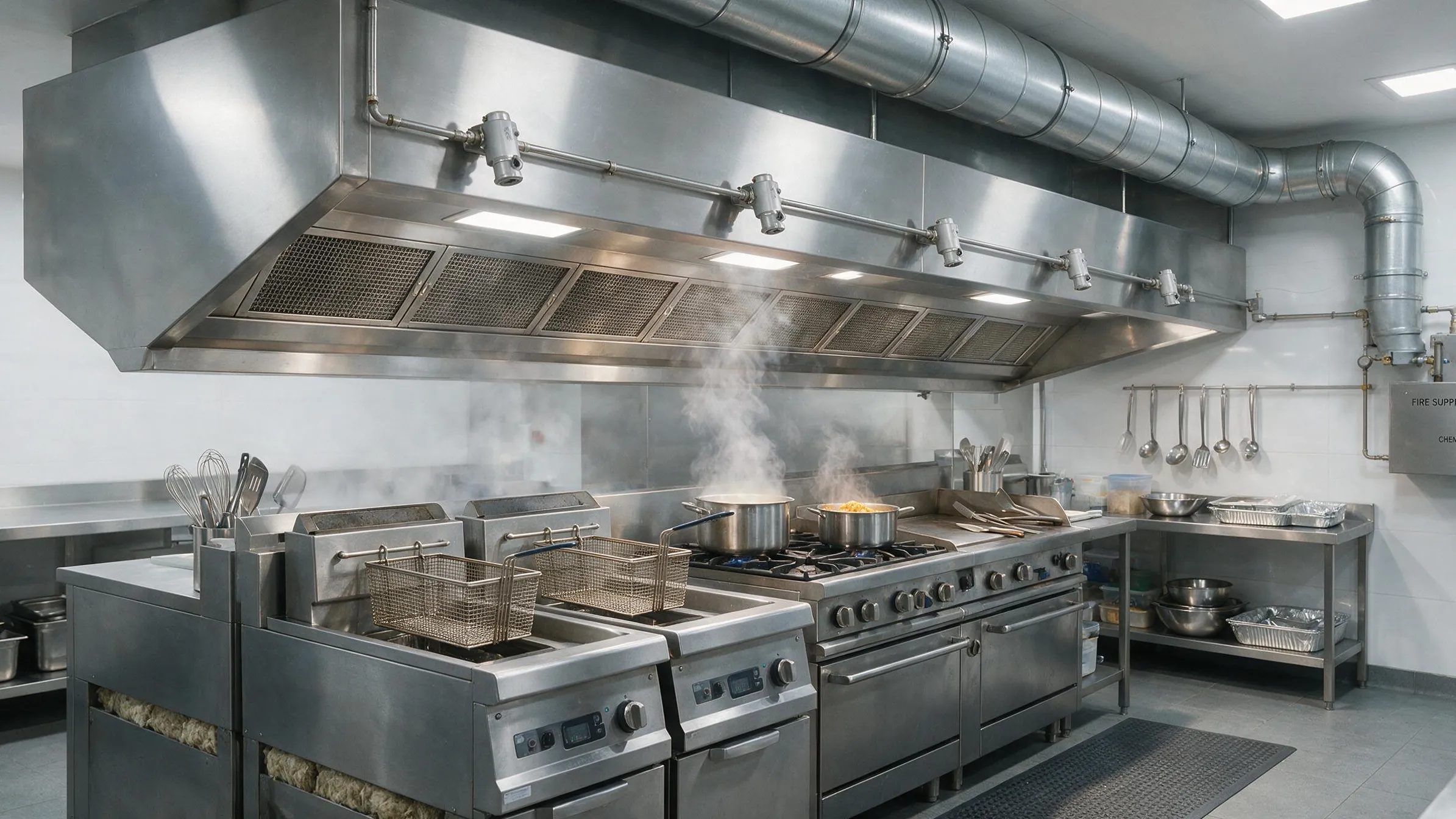
Wet chemical systems are commonly used for commercial fryers and cooking ranges. They are designed for Class F cooking-oil fires and typically discharge onto the appliance and into the canopy. They may be appropriate where open-vat frying or similar cooking equipment is the primary hazard - subject to manufacturer listings, system design, and the fire risk assessment. They are not automatically the correct answer for every cooking process or every kitchen layout.
Water mist may be suitable for some cooking or process hazards where the system is approved and engineered for that application. Suitability depends on tested application, equipment geometry, manufacturer or system approvals, water quality, and insurer acceptance. Water mist is not a general alternative to wet chemical, and it is not a drop-in replacement for an appliance-level wet chemical system without competent engineering review.
Extract canopy and duct considerations
Discharge at the appliance alone may not protect grease-laden ductwork. A fire can enter the canopy, plenum, and duct run even after local appliance suppression has operated. Design should consider whether canopy, plenum, and duct protection is required, how detection is zoned, and how discharge interfaces with fan shut-down and fire dampers. Passive measures and maintenance schedules matter as much as nozzles.
Building sprinklers and water mist for the wider space
Automatic sprinklers or water mist covering the kitchen or production hall can support structure and adjacent occupancy protection if fire escapes the cooking appliance. They support compartment protection and fire control; they are not always the appropriate first response to a deep-fat fryer fire at source.
Water mist systems for buildings are designed and tested under frameworks including BS 8489 and BS EN 14972. Where mist is proposed for food environments, confirm the relevant standard parts and editions, droplet behaviour, water quality, hygiene implications, and cleaning access with the designer and food safety team. Compliance with a named standard does not, on its own, prove suitability for a particular kitchen or process line.
Detection and shut-down interlocks
Kitchen protection often links detection or system activation to:
- Fuel or power isolation to cooking equipment
- Extract fan control as required by the fire strategy
- Alarm notification to staff and the fire alarm system
- Clear local indication of which zone has operated
False activations and accidental discharge carry commercial cost in food premises. Activation logic and maintenance quality deserve as much attention as nozzle layout.
Legal duties and wider guidance
Kitchen and food plant fire safety sits under legal duties and supporting guidance. Exact rules differ across the UK.
Legal duties
- England and Wales: the Regulatory Reform (Fire Safety) Order 2005 requires the responsible person to ensure a suitable and sufficient fire risk assessment and to take general fire precautions
- Scotland and Northern Ireland: separate fire safety legislation applies; confirm duties with local advisers
- Building Regulations: Approved Document B in England (or equivalent devolved guidance) addresses structural fire safety and means of escape for relevant building work
Guidance and related practice
- BS 9999 - risk-based code of practice for fire safety in the design, management, and use of non-residential buildings; guidance, not a substitute for statutory compliance
- Insurer and industry guidance - kitchen extract cleaning standards, appliance manufacturer instructions, and insurer survey recommendations often go beyond minimum legal requirements
A documented fire risk assessment for commercial kitchens should address cooking equipment maintenance, extract cleaning intervals, staff emergency procedures, and how suppression systems are inspected and reinstated after discharge.
What operators and designers should review on site
Before specifying or upgrading protection, review the actual kitchen or plant, including:
- Which appliances and process lines are present, and how they are used (including unattended or overnight operation)
- Oil type, vat capacity, and whether Class F local application is listed for those appliances
- Canopy, filter, and duct condition; cleaning records; and whether fire can travel beyond the appliance zone
- Existing sprinkler, mist, wet chemical, or detection systems, and whether they are coordinated
- Fuel, power, and ventilation interlocks - and whether they are tested and recorded
- Staff roles, shut-down procedures, and escape routes from the cooking or process area
- Food safety and hygiene constraints if any water-based system could discharge near open product
- Insurer expectations and any conditions attached to cover
Summary
Commercial kitchens and food production lines need a layered, site-specific strategy: control ignition sources through maintenance and housekeeping, protect the appliance and extract where the fire is most likely to start, and protect the wider building if fire spreads.
Wet chemical, water mist, sprinklers, and detection each have possible roles. The correct combination depends on the hazard, approvals, geometry, and a suitable and sufficient fire risk assessment - not on a generic product preference.
For a site-specific review of kitchen or food plant fire protection, see our food production page or contact our engineering team.